Tuesday, May 19, 2015

E. Mitchell's Evaluate 2.1.2 – Rubrics and Competencies Quest

For this section, set up a competency structure for one unit of your sample course. Associate the assignments in that unit with the competency. Submit both a screenshot of the structure and a detailed explanation of why you created the structure that way. Include a discussion of the various pathways a student may go through to attain the competencies in the unit and document all in your blog.


This is a unit on Sensation and Perception.  I selected this particular unit because of the vast amount of information embedded that College Board expects students to be familiar with.  Though this unit it enjoyable for them, it contains a LOT of content.  The competency I set up aligns with the College Board standards established for the topic.  Each standard is matched with an assignment (i.e. sensation is paired with a dropbox ppt assignment and perception is paired with a discussion).   In order to ensure that students have met standards, each is associated with a scoring guide rubric.  These help is making sure students are meeting and/or exceeding standards.  In order to help make sure they are attaining the competencies, students can make revisions to work (as suggested in my feedback).  The final demonstration of mastery aligns with a unit exam.  

Rubric one
Rubric two

E. Mitchell's Evaluate 1.1.3 – The Summative Assessment Quest

Showcase an assessment created and include how the method was used to assess the validity, reliability, and security. Post the assessment in your blog.

This is an assessment I created for my f2f class which integrates an online component.  When we lost a day due to the weather, I needed to keep my students on track for the AP exam so they had an online exam to take about famous contributors to psychology.  


This exam is valid because all possible questions relate to the required assessment.  Students are to be familiar with famous names and each question requires them to key in a name that relates to the pun-form contribution listed.  To help with security, you will also see that the exam is randomized and only shows one question per page. When an exam is reliable it yields consistent results (we discuss this in psych referencing ways to check this like split test reliability).  Two things prove reliability here.  First, I did allow each student 2 attempts on the exam.  Each time their score was different within a narrow range.  Secondly, the class grades were clustered around an average and the range was not wide.


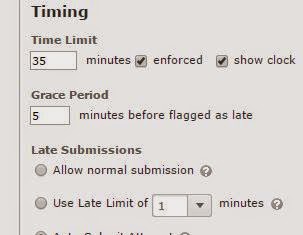
The dates of availability as well as the time limit help ensure security.


E. Mitchell's Evaluate 3.1.2 – Self-Reflection on Teaching Abilities Quest

Submit evidence of reflection on your individual teaching abilities. Include artifacts, evaluation feedback, your own reflections, e-portfolio links, professional growth plans and anything else that showcases introspection into strengths and weaknesses as an online educator and document all in your individual blog.
Each year with GaVS I learn new tricks of the trade that I believe help me continuously meet GaVS standards.  Opportunities like the PLS' as well as faculty meetings keep me plugged into GaVS happenings as well as school policy.  Additionally, getting the chance to present at PLS' helps me work collaboratively with fellow colleagues, forces me to do research as well as stay abreast of trends in online education.  Hopefully, I can keep this streak going!  


Click here to view my ePortfolio.

Monday, May 18, 2015

E. Mitchell's Evaluate 3.1.1 – Differentiation Quest

Provide sample data from student results for a course within your field. The data can be entirely theoretical and written out in text form.

Upon completion of the data, discuss the method used to group students based on abilities, strategies utilized to examine student performance, and areas requiring modification of instruction.
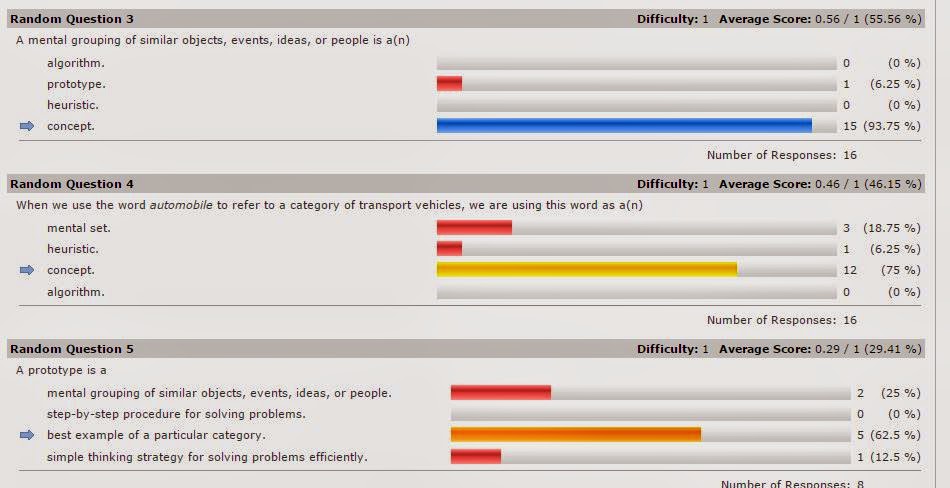
This screenshot was pulled from one of my practice exams.  For each unit I provide a practice exam that students can take with limitless attempts as well as instant feedback on the grade.  It is routinely the top scoring students in the course who capitalize on the opportunity to prepare for an exam.  This shows a question breakdown with selected answer choices.  I can easily see based on percentage correct which concepts have been mastered by majority of students and which concepts (like in question 3 above) may need clarification before the formal assessment.  This provides a great view into potential topics to discuss at the weekly adobe sessions when I have a chance to verbally address the concepts in more detail or post a news announcement with a video or link to illustrate the concept.  
Next, focus on the individual level. How could the data be referenced to identify the needs of each student? How could the settings of the LMS be used to create personalized learning paths? Note that a personalized learning path does not necessarily mean one student sees a resource no one else does, but that the overall order and selection of work one student does may be entirely unique from the order and assignments others did. 
Practice assessments can become mandatory to complete with a mastery score in order to access the formal unit assessment.  This mastery score could be set around a 70 and students could have limitless attempts to achieve it in order to access their formal exam.  In addition, this does not have to be a requirement for all; this could serve as a remediation opportunity for those with 70 or below in the course.  

E. Mitchell's Evaluate 2.1.1 – Data Driven Instruction, Analytics, Reporting Tools Quest

Review the artifacts above on student enrollments and student progress in the course. Then, provide a detailed description of all that this information tells you about the hypothetical course. Include how the teacher might adjust the course in the future based on the previous activity of these students. Document in a reflection on your blog.

Information about student enrollments

When I view student enrollment I get a good sense of the demand of the class.  My course is taken by many students who could not get the f2f version in their schedule or students in which the course is not offered at their school.  I can see clusters of students which gives me a good idea of who is potentially working together on assignments, either in a positive or negative way.  The student enrollment data can also tell me a little about their access to technology based on the region they live.  Additionally, the student enrollment data can allude to structure in the home which one has to be mindful of when communicating with parents.  

Student Progress in the Course

This one is a favorite of mine that I use in communication with parents.  What I notice with my top students is multiple visits to the content modules.  I view it as they are progressively working through the units by previewing the material first, getting a plan of what they need to do and how much time it will take, and then going back to complete the assignment.  Students who adhere closely to my suggested daily schedule trend in this way.  Then I have students who flood the course with their submissions Thursday, Friday, and Saturday of the benchmark due date.  This is obvious when looking at their progress because they tend to access the content minimally, usually understand estimating their time to complete assignments.  When communicating with parents about quality of work, this is a great tool to rely on; some students need to manage their time better. One of the things I wanted to start doing in the future is keeping assignments and content locked until submissions are made.  This could force a student to work on time management to ensure he/she has access to all coursework or exams.  This could also help alleviate a burden with grading; submissions spaced out of the benchmark period usually get more quality feedback than those submitted at the time minute due to the grade report time.  

E. Mitchell's Evaluate 1.1.2 – Quality Feedback Quest

In your blog, provide a student work sample and accompanying feedback that showcases some of the expectations listed above and offers a sound example of quality, authentic feedback. Discuss aspects of the sample that align with the best practices discussed in this quest.


Student Work Sample:


Feedback:

You impressed me with your submission for this assignment girl!!  To begin, I thoroughly enjoyed how you provided a clear identification for each specific brain structure.  This helps establish your knowledge of the function to ensure proper application.  Each application uniquely gives your perspective of driving highlighting all of the ways in which the brain plays a major role in allowing this to happen!

1.      Cerebellum– I like how you apply the role this plays with balance and coordination but also the demonstration of procedural memory! 
2.      Medulla- mastery 
3.      Pons–mastery 
4.      Reticular formation –mastery 
5.      Thalamus – You clearly show knowledge that this is the sensory switchboard for all senses except smell!
6.      Hypothalamus
7.      Amygdala –mastery 
8.      Hippocampus –mastery 
9.      Corpus Callosum–mastery 
10.  Frontal Lobe (which contains the motor cortex) –
a.       Broca’s area (14)  –  Broca's Area controls your "Boca" (if you are familiar with Spanish, this is a great memory aid for the national exam!)
11.  Temporal Lobe: auditory cortex – Easy to remember when you think about the location of your temples =)
a.       Wernicke’s area (15)  -mastery 
12.  Occipital Lobe (which contains the visual cortex) –mastery 
13.  Parietal Lobe (which contains somatosensory cortex) – mastery 


E. Mitchell's Evaluate 1.1.1 – Formative Assessment Quest

How might a teacher employ ways to assess student readiness for course content and method of delivery? To demonstrate this, create a formative assessment in a demo course you are creating. Post a link to the assessment in your blog.

When I first started teaching at GaVS, the AP Psych course was really lacking in formative assessments.  The course really entailed just reading quizzes and papers.  When I redesigned the course, I wanted to incorporate two assignments per unit that ensure students were exposed to certain College Board standards as well as at least one discussion.  Additionally, each unit has a multiple choice as well as written assessment.  One of my favorite assignments has the students work collaboratively to create a pre-school. Their website must be designed as they would advertise to parents about potential students.  They are required to incorporate the contributions of major unit theorists by creating unique activities that would entice a parent to enroll their student.  It is awesome to see what they come up with because many of the activities match what my children do in pre-k!    

Pre-School Assessment
Pre-School Assessment Rubric